How to network for a job, in short: find the work contacts you already have at the companies you want. Ask them for advice, then for a referral. We suggest starting with work contacts. A 2021 New York Fed study compared US workers’ referral sources and starting pay. A referral from a business contact went with pay about 16% higher than no referral. One from family or friends went with pay about 9% lower. These are associations, not proof that the referral caused the difference.
Ask an AI about networking
These open a chat with the question already typed, pointed at this page. It asks for a balanced answer, including where Kola is the wrong choice.


The hard part is knowing who you know at each company. Kola, a Mac app that remembers the people you know, answers that from your email, calendar and messages. Below is one job search told through Kola’s chat, from the first question to the offer, then the method and the studies behind it.
Kola reads your email, calendar and messages, and builds one page for each person you know. You ask Kola a question in plain words, and it answers from those pages. It runs on an Apple Silicon Mac.
Your people, messages and notes stay on your Mac. Three features you switch on yourself send data out: the AI assistant, contact enrichment and profile photos. The security page explains each one.
In this invented example, Emma is an account manager at Hartley who wants a sales job at Quantia Cloud. The story runs from her first question on 7 September to an offer on 20 October. Each step is one question she asked Kola.
Emma, her contacts and their messages are invented, and the screenshots come from Kola’s demo profile. The dates and the offer show the method, not a measured result. A referral helps, but it does not promise an offer.
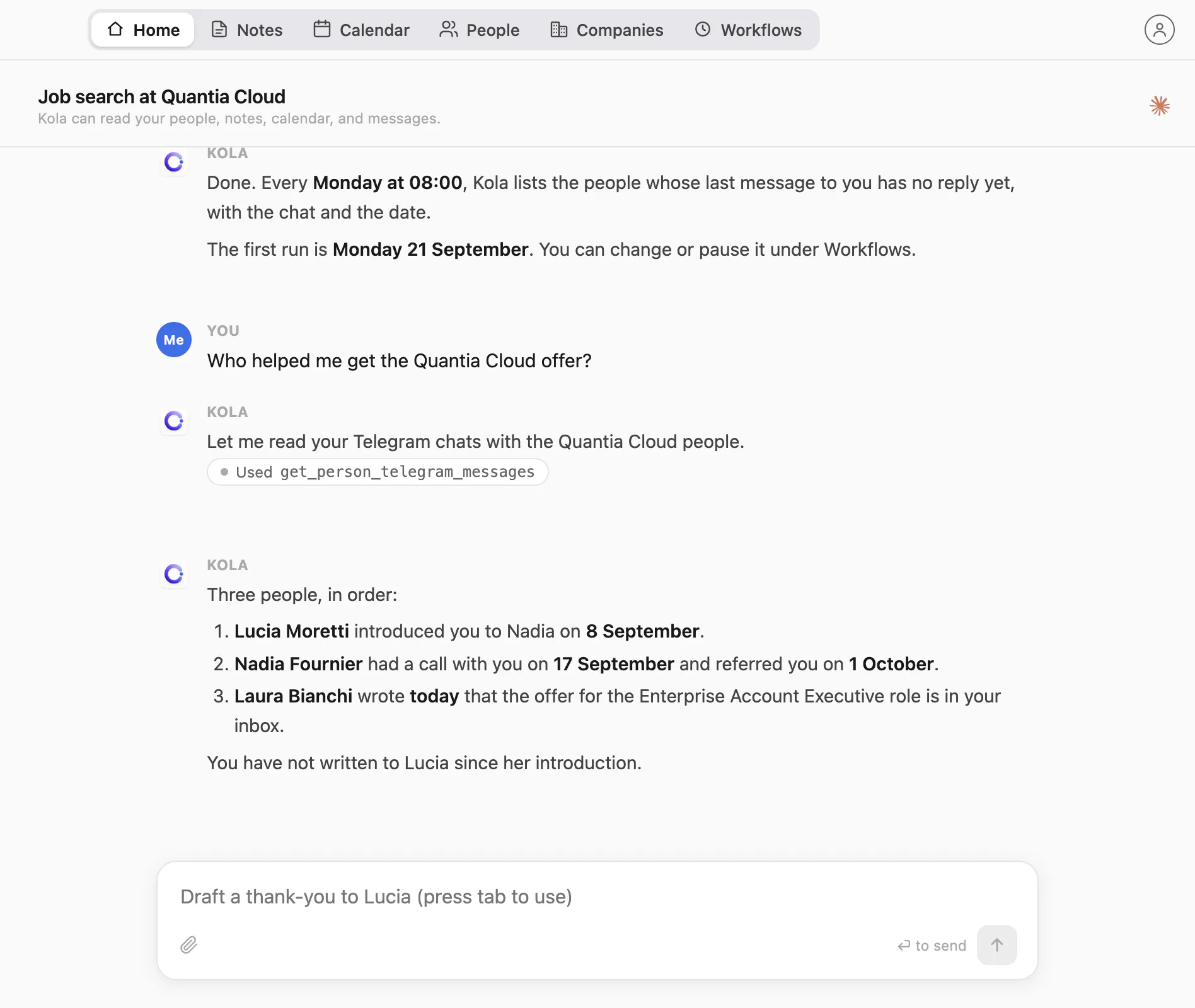
1
Kola listed five people, their roles and the last meeting with each. Nadia Fournier, a sales executive, had the job Emma wanted.
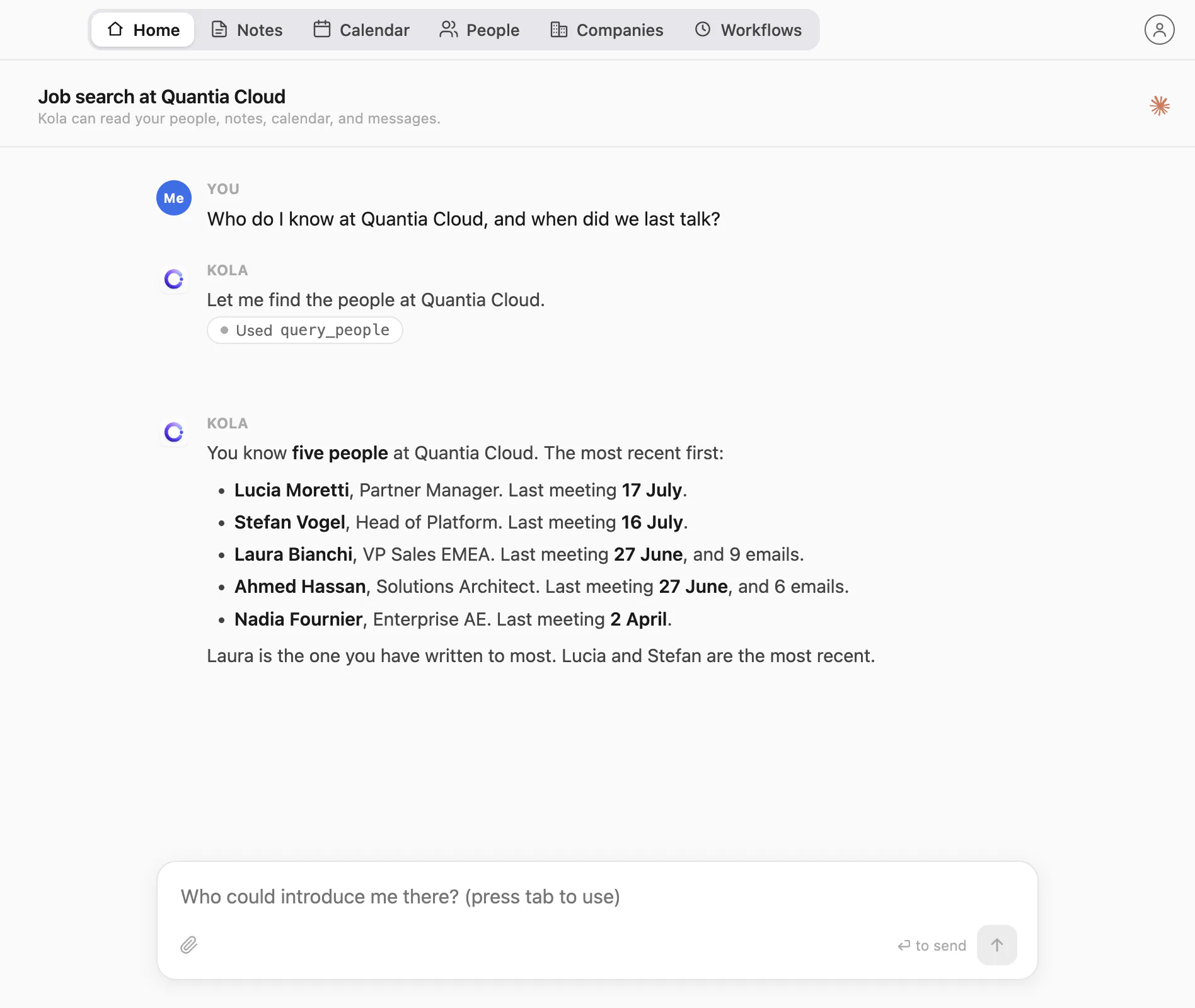
2
Emma had met Nadia once, at a pipeline review on 2 April. Kola found two people from that meeting who know them both, and Lucia Moretti was the more recent contact.
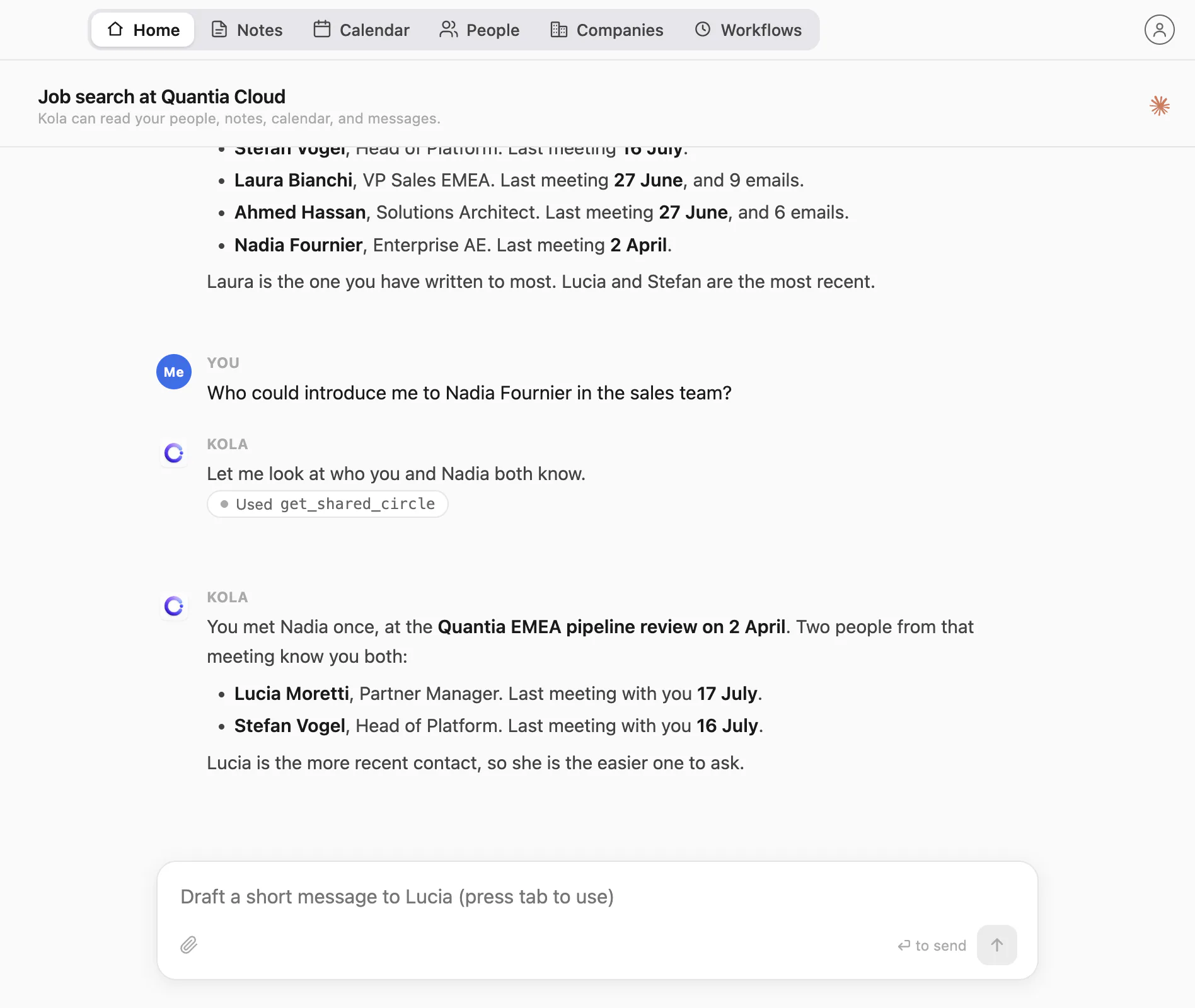
3
Lucia introduced them on 8 September, and Nadia agreed to a 20-minute call. Before the call, Kola’s Brief put the history and the next question in one place.
4
Nadia said the role would open in October and that she would refer Emma then. Kola found the two things Emma had promised in return.
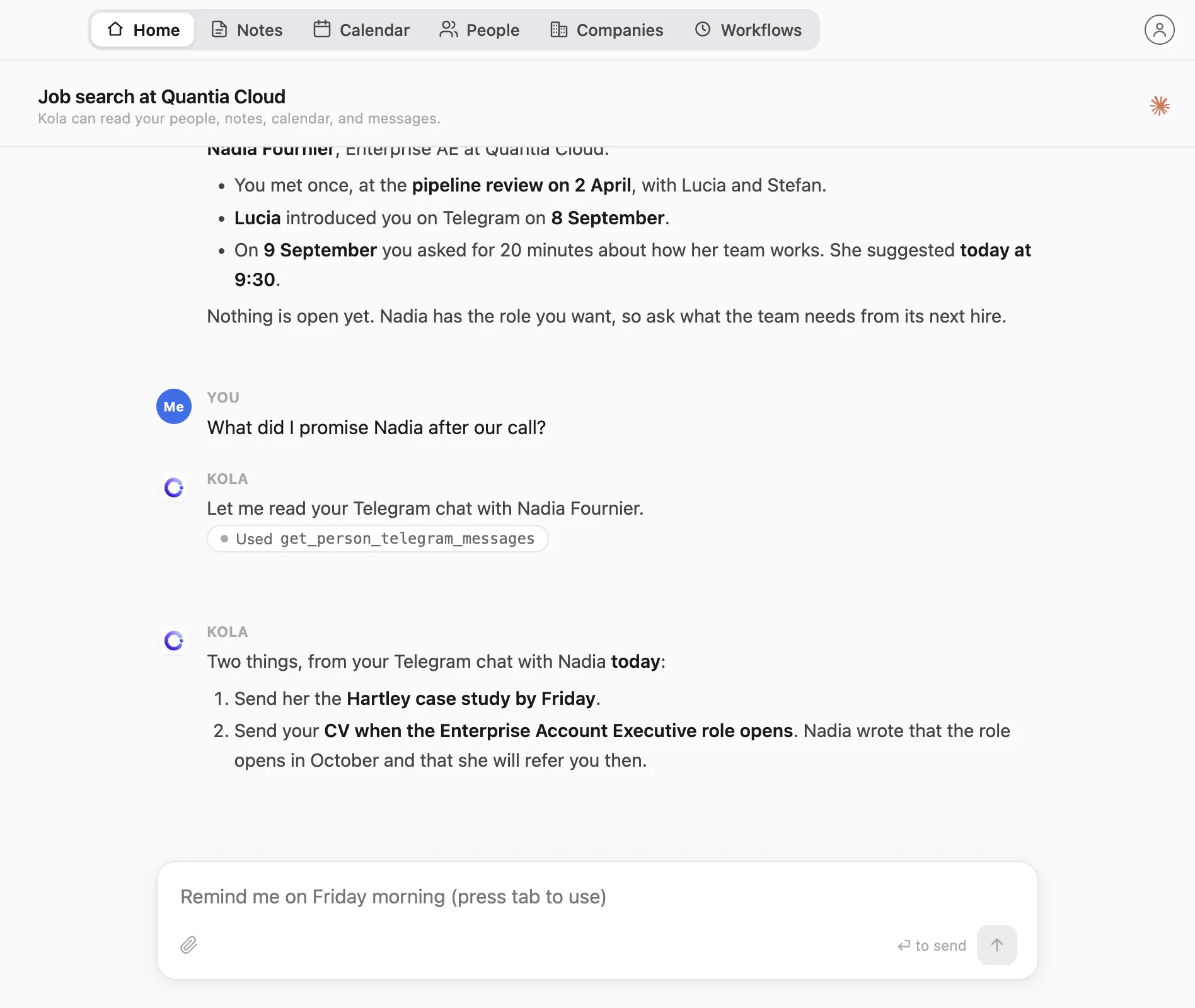
5
Kola turned the request into a workflow, an instruction it runs on a schedule. Every Monday, Emma saw the messages that still needed a reply.
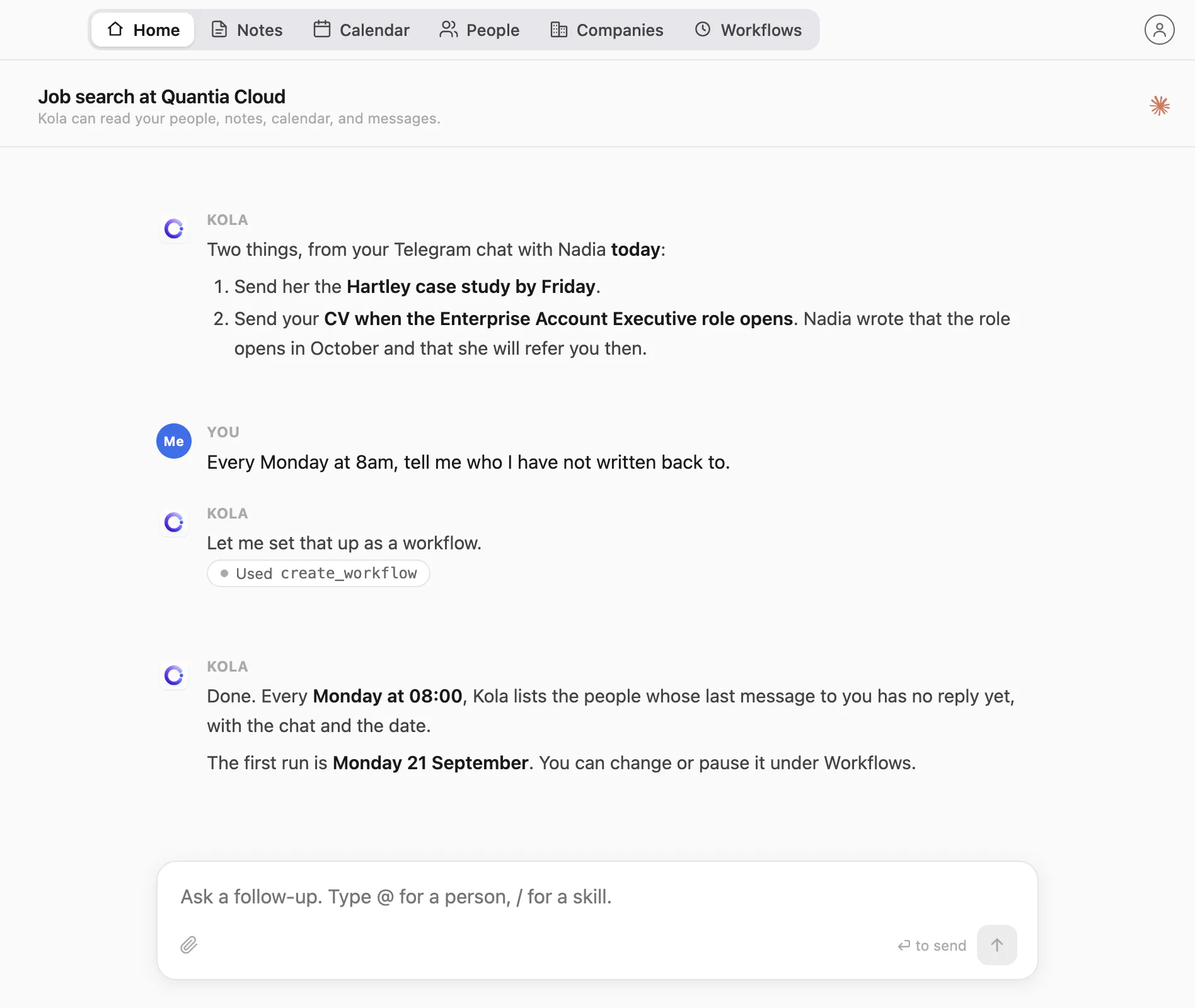
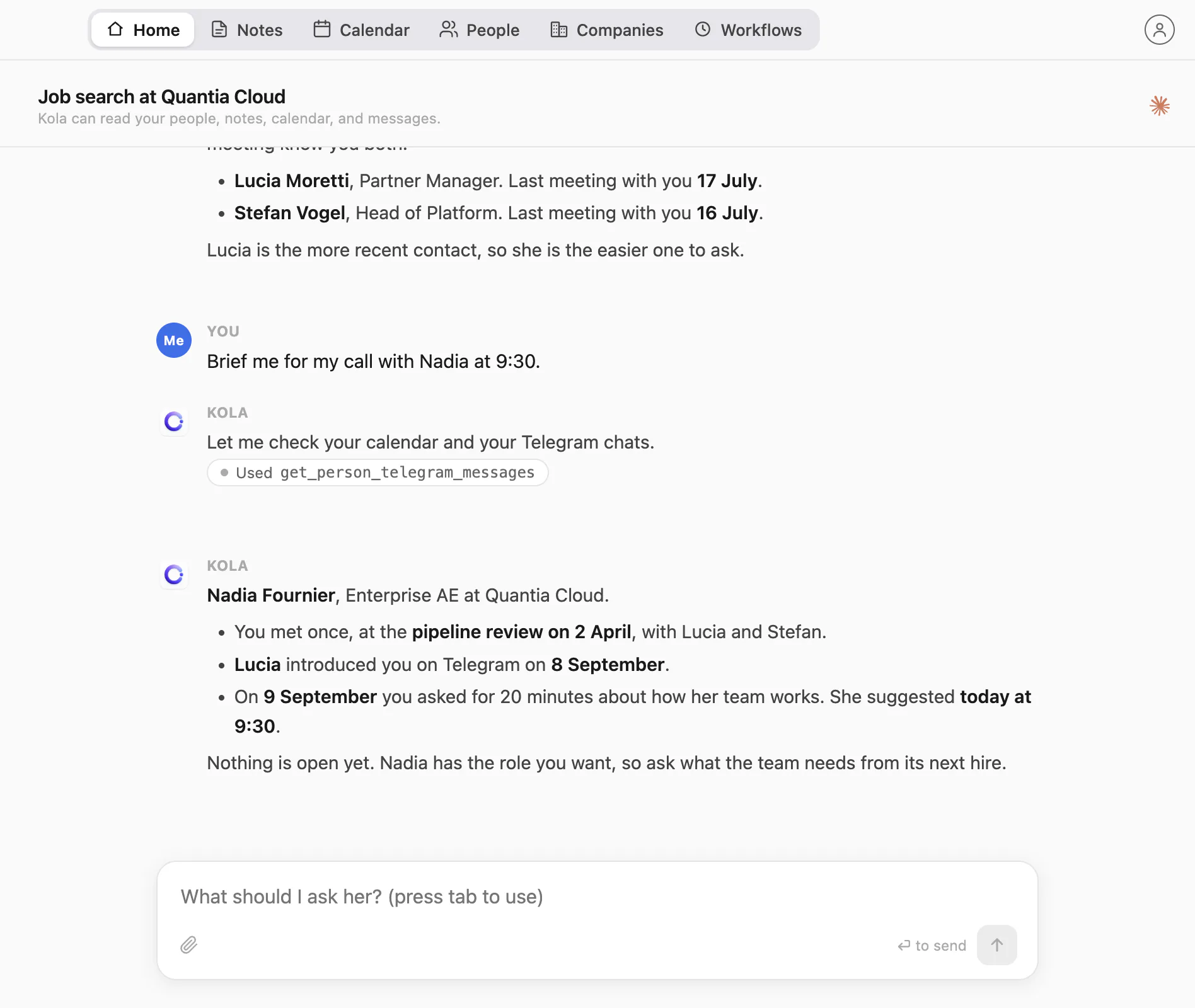
6
The role opened on 1 October, Emma sent her CV, and Nadia referred her. On 20 October, Laura Bianchi wrote that the offer was in Emma’s inbox. Kola listed who had helped, and that Lucia had not yet been thanked.
Pick the companies first, because a contact is useful only when you know what to ask them. Then each message can name the company and say what you want to learn.
Ask for an introduction with the person’s name and the reason. Emma’s message to Lucia:
Hi Lucia. I am looking at a move into enterprise sales, and Quantia Cloud is first on my list. Would you be comfortable introducing me to Nadia Fournier? We met at the pipeline review in April.
Our recommendation is to start with contacts who know your work or the company, close or not. The research does not set one best order for asking people. Three large studies measured different outcomes: starting pay, later working together, and job moves.
| Kind of contact | What the study found | Study |
|---|---|---|
| A business contact who refers you | Starting pay about 16% higher than with no referral (an association, not proof of cause) | New York Fed survey of US workers, 2021 |
| Family or a friend who refers you | Starting pay about 9% lower than with no referral (an association, not proof of cause) | New York Fed survey of US workers, 2021 |
| Weak ties, people you see now and then | Most people who later worked with a friend worked with a weak tie, because there are many | Facebook, 6 million US users, 2017 (observational; working together stands in for help) |
| One strong tie, a close contact | More strongly linked to later working together than one weak tie | Facebook, 6 million US users, 2017 (observational; working together stands in for help) |
| Moderately weak ties, measured by mutual connections | Led to the most job moves | LinkedIn experiments, 20 million people, 2022 |
The pay figures come from Benjamin Lester, David Rivers and Giorgio Topa at the Federal Reserve Bank of New York (2021). They used the Fed’s Survey of Consumer Expectations, a nationally representative US survey. The study controls for region, time and worker traits, but the gaps are correlations: they do not prove that the referral caused the difference.
The tie figures come from Laura Gee, Jason Jones and Moira Burke, who studied 6 million US Facebook users (Journal of Labor Economics, 2017). They found that “a single stronger tie is significantly more valuable at the margin”. In their data, 10 percentage points more contact with a friend went with at least a 20% higher likelihood of later working with that friend. The study is observational, and working at the same firm later stands in for job help.
Karthik Rajkumar and four colleagues ran experiments on LinkedIn with more than 20 million people over five years (Science, 2022). Moderately weak ties, counted by mutual connections, created the most job mobility.
The studies answer different questions, so they do not conflict. In the Facebook data, weak ties gave most of the help because people have many of them, while each strong tie was worth more. In the LinkedIn experiments, moderately weak ties created the most job moves when closeness was counted by mutual connections, and the weakest ties did when it was counted by how often people interacted. For your search, that means writing both to former colleagues and to close contacts who know the company or your work.
Ask for a short conversation about their work, and say how long it will take. The US Bureau of Labor Statistics describes an informational interview as a meeting of 20 to 30 minutes, whose purpose “is not to get a job”. A request that small is easy to accept.
Emma’s message to Nadia after the introduction:
Hi Nadia. Lucia kindly connected us. I am looking at enterprise sales roles, and you have been at Quantia Cloud for two years. Could I have 20 minutes next week to ask how your team works? A call is fine.
Offer a call or a coffee when you can. Mahdi Roghanizad and Vanessa Bohns summarise the research (2022): people agree to requests made in person more often than to requests sent as text, and the people asking underestimate the difference.
To prepare for the coffee chat, read the job description, then bring three questions:
Let the other person do most of the talking. Why trying to impress people backfires explains why questions work better than talking about yourself.
Ask for a referral after the advice conversation, for one specific job, and make it easy to say yes. Send the job link, your CV and two lines on why you fit. Then the person can forward your message as it is. Emma’s message to Nadia on 1 October:
Hi Nadia. The Enterprise Account Executive role is live (link). My CV is attached. At Hartley I manage business customers like the ones your team sells to. You said the team needs someone who knows them. Would you be comfortable referring me? If not, no problem at all.
Keep the last sentence. The person may not know your work well enough to recommend you, so give them a polite way to decline.
Stephen Burks and three colleagues studied personnel data from nine large firms (Quarterly Journal of Economics, 2015). Referred applicants were more likely to be hired than other applicants with similar skills, and referred workers were less likely to quit. These are comparisons between groups, not a promise for one applicant.
Follow up within a day with a thank-you, and again when something happens. Each conversation can leave a small promise, for example an article you said you would send or an update after an interview.
When the job search ends, tell everyone who helped you where you went. The people who helped you stay your work contacts for the next search. For the people you have not spoken to in years, see how to reconnect with someone professionally. If your work chats are in Telegram, you can also connect Telegram to ChatGPT or Claude through Kola.
Start with the companies, write to the people you know there, and keep each promise you make.
Are 85% of jobs really filled through networking?
The claim that 85% of jobs are filled through networking is not a reliable estimate for all jobs. Recruiter Lou Adler reported it in a 2016 LinkedIn post, from a voluntary online survey of about 3,000 people who chose to answer, most in staff or management roles. It is not a representative sample of workers or hires. The headline says “all jobs”, and the text says “critical jobs”.
How do you network for a job when you already have one?
When you already have a job, network for a new one through advice conversations with people outside your company, and keep the search private. Ask former colleagues, clients and people from your industry for 20 minutes about their work. Do not post that you are looking. Tell each person that the search is confidential, and ask for referrals only to specific roles.
Should you ask close friends or old colleagues for job help?
For job help, we suggest asking old colleagues and other work contacts first, without leaving out close friends who know the company. In a 2021 New York Fed study of US workers, a business-contact referral went with starting pay about 16% higher than no referral, and a family-or-friend referral with pay about 9% lower. These are associations, not proof of cause. In the 2017 Facebook study by Gee, Jones and Burke, one strong tie was more strongly linked to later working together than one weak tie.
Install Kola and connect an account. Kola builds your contacts from there.