
Strength scores each person from 0 to 100. It counts how much you talked and how recently, so it falls on its own as a relationship goes quiet.
Name the gap, say why you thought of them, and ask for one small thing. Being contacted is welcomed more often than senders expect.
Strength scores each person from 0 to 100. It counts how much you talked and how recently, so it falls on its own as a relationship goes quiet.
Ask an AI about reconnecting
These open a chat with the question already typed, pointed at this page. It asks for a balanced answer, including where Kola is the wrong choice.


Name the gap in your first sentence. Then say why they came to mind, and ask for one small thing.
Keep it to three or four sentences. A short message can be answered between meetings. A long one waits until they have more time.
Do not open with an apology. An apology asks the reader to reassure you before they can answer. Stating the gap plainly does the same job and costs them nothing.
Asking for advice
Hi Jane. We have not spoken since the Northwind Robotics project two years ago. I saw your post about shipping delays and thought of you. Do you have ten minutes next week to tell me how you cut yours? No problem at all if next week is busy.
Asking for a name
Hello David. It has been three years since we worked together at Kestrel Biotech. I am looking for a design agency. Could you send me the name of the one you used?
It will probably be more welcome than you expect. People underestimate how much others appreciate being contacted.
Peggy Liu and three colleagues showed this in 2023. The person who receives the message reacts to the surprise of it. The person who sends it does not account for that surprise.
Careers move. People change jobs, cities and teams. A quiet year is common between working people.
You may feel awkward writing it. That feeling is not part of what the other person reads.
Start with people you have not spoken to for about three years. Their advice is as useful as advice from your current contacts, and often more useful.
Daniel Levin, Jorge Walter and Keith Murnighan asked hundreds of executives to do exactly that in 2011. The advice they got back was more novel, and it took less work to get. The pool of useful old contacts was deeper than the executives had expected.
The reason is older still. Mark Granovetter showed in 1973 that new information usually arrives through people you are not close to. Close contacts read what you read.
There is a limit, and it was measured on a different question. Karthik Rajkumar and four colleagues studied job finding on LinkedIn in 2022, across more than 20 million people and five years. Moderately weak contacts helped most. The very weakest helped less than that.
A long gap is not a reason to stay silent. Five and ten years both work, as long as you name the gap and keep the request small.
The length of the silence changes the size of what you ask for, not whether you write at all. After a year you can ask for a coffee. After five, ask a question they can answer in two lines.
After ten years, ask about them first. Let them decide how much time to give.
A reply comes when the message is specific and easy to answer. The reader should know what you want after one read.
Give a reason for writing today. A post they published, a new role, a funding round. Without one, the timing reads as random.
Make the next step small. A two-line answer takes two minutes. A video call takes half an hour and a negotiation over calendars.
Leave them a way to say no. One line is enough, and it takes the pressure out of the request.
| What the message does | Gets a reply | Gets ignored |
|---|---|---|
| The ask | One specific question | A general catch-up |
| The history | Names when you last worked together | Assumes they remember |
| The next step | A two-line answer | An hour-long lunch |
| The timing | Says why you are writing today | Gives no reason at all |
| The opening | Names the gap in a few words | Apologises for a paragraph |
Put the request in the first message. Hiding it behind a catch-up note costs them a reply and reads as a trick when it finally arrives.
Say why you are asking this person. Name the thing they know that other people do not. That is what separates a request from a mass mailing.
Ask for the smallest useful version. A name, a link, or one sentence of opinion. You can ask for more once they have answered.
Offer the exit in the same message. It costs one sentence, and it makes the request easy to receive.
Kola tells you who has gone quiet and reminds you what you last talked about. It reads the accounts you already use and keeps everything in one file on your Mac.
Start with who. The People list has a Last touched column and a Strength column. Sort by either one and the quiet names come to the top.
Strength is a score from 0 to 100, and Kola works it out for every person on its own. It counts how many times you were in touch and how recently, across every account you connected.
The score fades with silence. It holds steady for about two weeks after you last spoke, then falls away over the next two months. A name that used to sit near the top and now sits in the middle is a relationship going quiet, and you can see it before you have thought about it.
A note you write about someone counts too, and it counts double. Writing something down is your own attention, not traffic that happened to you.
Then read back what you last discussed. Each person has a page holding their emails, meetings, messages, notes and recorded calls. A timeline shows the relationship month by month, and the silence is visible on it.
Then find a reason to write today. Kola can read a person's recent public LinkedIn posts when you ask, and keeps nothing from them. Search works by meaning, so "who complained about onboarding" finds the message that said "the setup took us three weeks".
The message is still yours to write. Kola brings the name and the context. The words are yours.
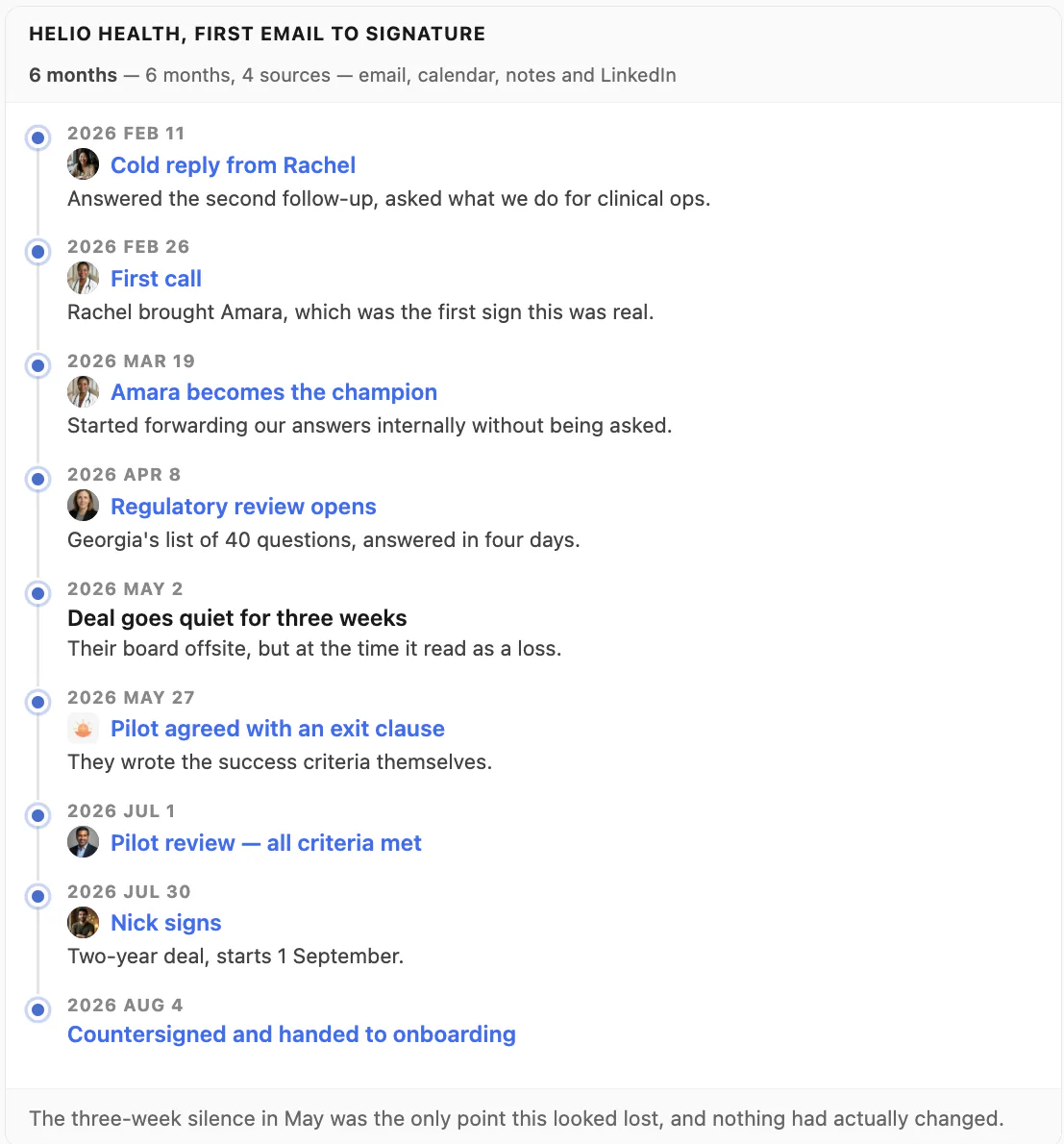
One relationship, month by month. The gap is part of the picture.
Give the job a schedule instead of your memory. One short list a week is enough to stop a two-year gap from forming.
In Kola that list is a workflow: a name, an instruction in your own words, and a schedule. Kola runs it on its own and writes what it found on a run page. This is the instruction to write.
The reconnect workflow
Every Monday at 08:00, list the ten people with the highest Strength that I have not spoken to in ninety days. For each one, give me the date we last spoke and what it was about, and anything they have posted on LinkedIn since. Then draft a message of three sentences: name the gap, say why I thought of them, and ask one question they can answer in two lines. Do not send anything.
Every clause in it does one job.
| Part of the instruction | What it does |
|---|---|
| Every Monday at 08:00 | The schedule. Kola runs it without being asked, so the list does not depend on you remembering. |
| The ten people with the highest Strength | Who matters. Strength ranks people by how much and how recently you were in touch, so the list starts with real relationships. |
| I have not spoken to in ninety days | Who has gone quiet. This is the Last touched column, read across every account you connected. |
| The date we last spoke and what it was about | The context, taken from the emails, meetings and notes already on that person's page. |
| Anything they have posted on LinkedIn since | The reason to write today. Kola reads the recent public posts when the workflow runs and keeps nothing from them. |
| Draft a message of three sentences | The first draft, written onto the run page. You edit it into your own words. |
| Name the gap, say why, ask one question | The shape of the message, taken from the first section of this page. |
| Do not send anything | The limit. Kola writes the draft onto the run page and sends nothing. You read it and press send yourself. |
Small notes keep the line open. A link they will find useful, two lines after a funding round, a word when they change job.
Kola also stores a birthday and shows it on the calendar. You get a reason to write once a year, on a date you did not have to remember.
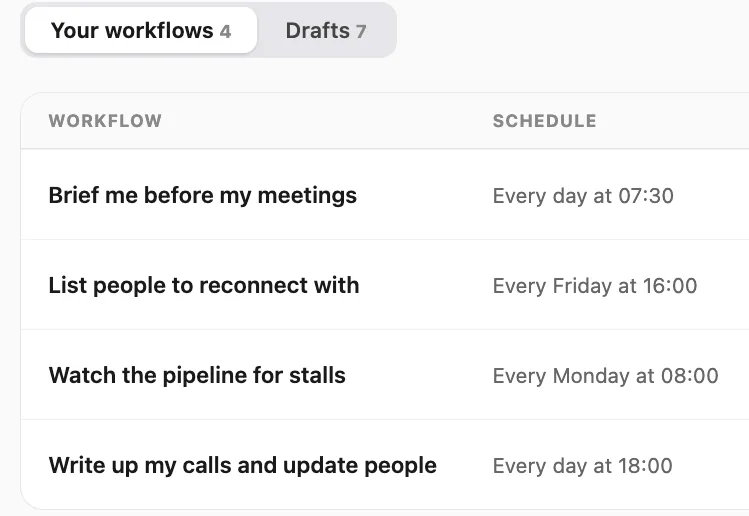
A workflow is an instruction and a schedule. Kola runs it without being asked.
Four studies, all published and all linked. Nothing on this page is measured by us.
Do I need to explain why we lost touch?
No. An explanation reads as an excuse, and the reader did not ask for one. Name the length of the gap in a few words and move to the reason you are writing today.
Should I apologise for not being in touch?
No. An apology asks the reader to reassure you before they can answer your question. Naming the gap plainly does the same work and asks nothing of them.
Should I ask for a call in the first message?
A call is a large request for someone who has not heard from you in years. Ask for something they can answer in two lines. Offer the call once they have replied.
What should I do if they never reply?
Leave it. Silence has many causes, and a full inbox is a common one. One short follow-up a few weeks later is fine, and a third message is not.
Where does Kola keep my contacts?
In one file on your Mac, under Application Support. Three features you switch on yourself do send data out, and the Security page names each one.
Install Kola and connect an account. Kola builds your contacts from there.