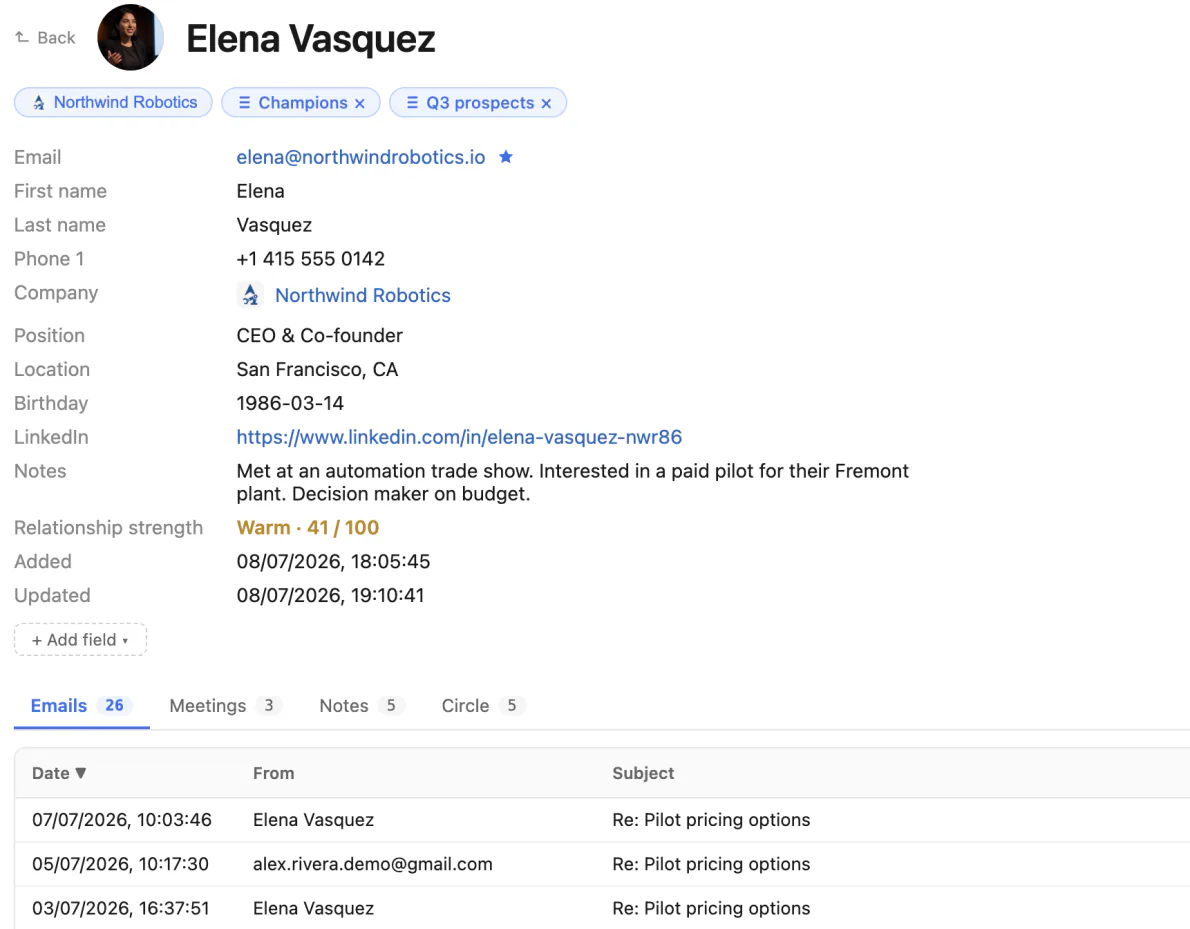
One person, and the two lines you would never have remembered. Details are what keep a conversation about them.
The bad feeling comes from doing it for yourself. Shared interest, something to give and a reason past your own career all reduce it.
One person, and the two lines you would never have remembered. Details are what keep a conversation about them.
Ask an AI about networking
These open a chat with the question already typed, pointed at this page. It asks for a balanced answer, including where Kola is the wrong choice.


Because it is done for your own advancement. The same conversation, held to make a friend, does not produce the feeling.
Tiziana Casciaro, Francesca Gino and Maryam Kouchaki measured this in 2014. They asked 306 working adults to write about a time they networked. Half wrote about networking to get ahead at work. Half wrote about networking to make friends.
Everyone then completed part-written words, among them W _ _ H and S _ _ P. The group who had written about getting ahead made them WASH and SOAP twice as often. The group who had written about friends made them WISH and STEP.
That is not dislike. It is the mind reaching for a shower. The researchers called it moral contamination, and the word people themselves use is dirty.
Avoiding it has a price. In the same research, 165 lawyers at a large North American firm were studied at work. Those who found networking distasteful and stayed away from it billed fewer hours than their colleagues.
Go in to learn one thing rather than to get one thing. With nothing to ask for, learning is the only thing left to do.
The same team compared two ways of showing up, in labs in the United States and Italy and among a further 174 lawyers at that firm. Some people networked because they wanted to and expected to find something interesting. Others treated it as a duty of the job.
The people who treated it as a duty felt inauthentic while doing it, did it less often, and did worse on the work measures in the study.
What separated the two groups was the reason they were in the room. Nobody measured whether one group was born more sociable than the other.
So pick the thing you want to learn before you go. One question you cannot answer from your own desk is enough.
Then ask about the work, not the job title. A job title produces a summary. A problem produces a conversation.
Produces a summary
So what do you do at Northwind Robotics?
Produces a conversation
You moved the plant onto a new scheduler last year. What broke first?
More than you are counting. The people who feel they have nothing to offer are the ones who benefit most from asking, and they ask least.
Two studies at that law firm found senior people were far more comfortable networking than junior people. The reason was not seniority itself. It was the belief that they had something worth giving.
A controlled experiment closed the loop. People made to feel powerful found networking less repulsive and were more willing to do it than people made to feel powerless.
The mistake is in the counting. Most people count money, contacts, technical help and information, then stop. Thanks, attention, and what you happen to know are left out of the total.
| What you have to give | How people count it |
|---|---|
| Money and budget | Counted |
| An introduction | Counted |
| Technical help | Counted |
| Thanks, said specifically | Left out |
| Saying so publicly | Left out |
| What is new in your corner | Left out |
| Reading their work first | Left out |
The four left out cost nothing and are rarely given. Junior people also know things senior ones do not, about new tools and about how the work is changing.
Assume it went better than it felt. Two separate effects say your reading of the room is too harsh, and both have been measured.
The first is the liking gap. Erica Boothby and three colleagues had strangers talk, then rate each other. People were liked more than they thought they were, and the gap lasted for months among new university housemates.
The second is what happens when you ask. Francis Flynn and Vanessa Bohns had people make direct requests for help to strangers. Askers underestimated by as much as half how many would say yes.
Feeling like a fraud is common enough to have been counted. A review of 62 studies covering 14,161 people put the reported rate anywhere from 9 to 82 per cent, depending on the test used.
One more finding is worth having before an event. Nicholas Epley and Juliana Schroeder asked commuters to talk to a stranger on the train. They expected it to be worse than sitting alone, and it was better.
None of this makes the feeling go away. It does mean that in these situations the feeling reads low, so it is a poor guide to how the conversation actually went.
Being in touch when you want nothing. A contact who only hears from you when you need something is in a transaction, whatever tone you write in.
There is a measured version of this. At the law firm, some lawyers networked for the firm and the client. Others networked for their own careers.
The first group felt more authentic and less dirty. They also networked more often, and they billed more hours. The three were measured together at one firm, so read them as one picture rather than a chain of causes.
So find the reason that is not about you. Your team, your customers, the people who come after you. It has to be true, or you are back where you started.
| How the relationship runs | Lasts | Stays a transaction |
|---|---|---|
| When you make contact | When you have something to give | When you need something |
| What you remember | What they are working on | Where they work |
| Why you went | To learn one thing | To be seen |
| Who it is for | The client, the team, the field | Your own next step |
| The follow-up | Names the thing you discussed | Great to connect |
Kola remembers the details, so the conversation can be about them. It reads the accounts you already use and keeps everything in one file on your Mac.
Every person has a page. Their emails, meetings, messages, notes and recorded calls sit on it, next to their company, role, location and birthday.
The useful part is the note. What they are building, what went wrong last quarter, the thing they said they were looking for. That is the material a real conversation is made of, and it is exactly what memory drops first.
Search works by meaning, not by keyword. Ask who was complaining about hiring and you find the message that said "we have had the role open since March".
That is the search that finds something to give. Somebody told you what they needed months ago, and you already know the person who has it.
Kola can also read a person's recent public LinkedIn posts when you ask, and keeps nothing from them. That is how you react to the work rather than to the job title.
Writing to someone after years of silence is its own problem, with its own evidence. We wrote it up in how to reconnect with someone professionally.
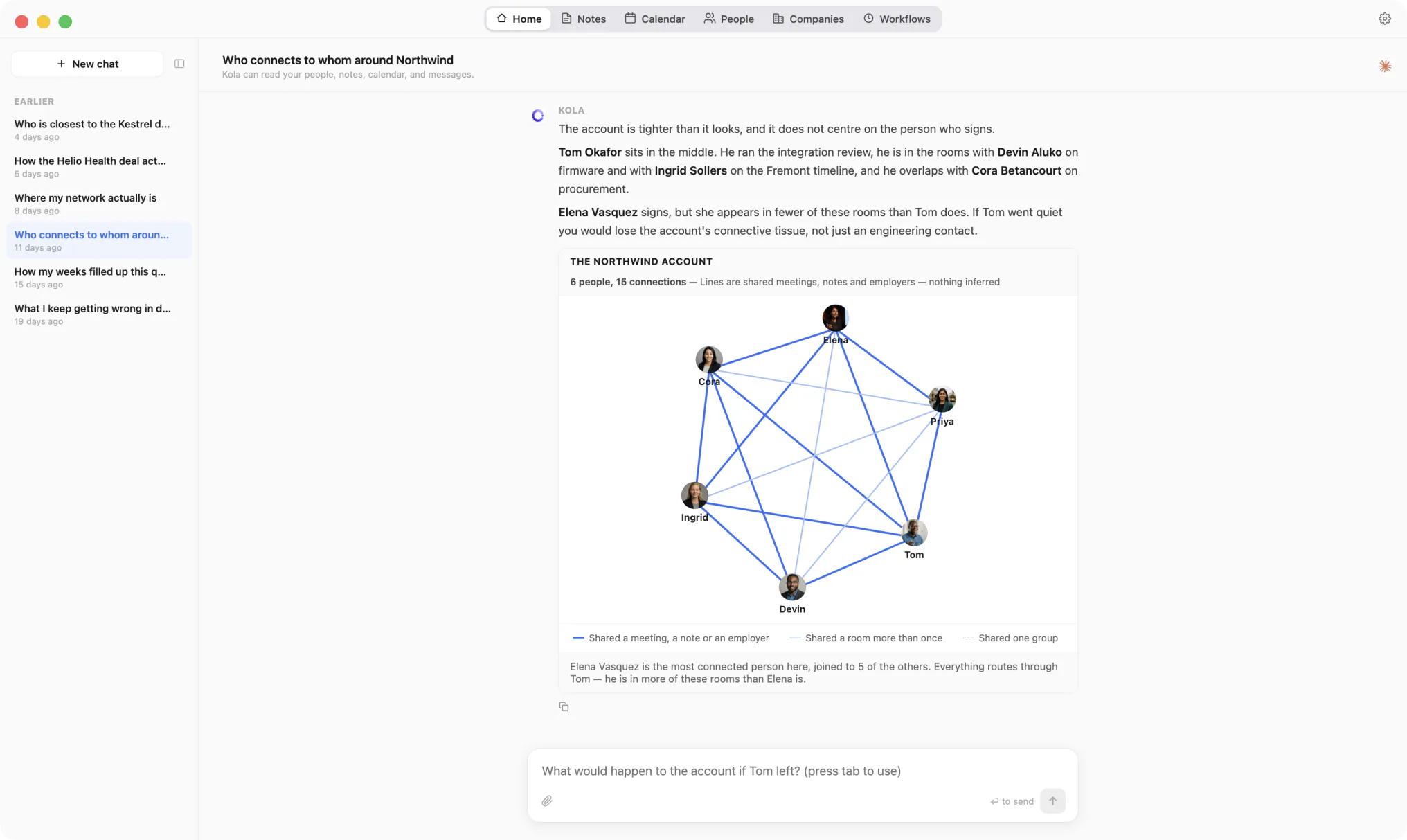
Every line is a shared meeting, note, employer or group. Kola draws no line it cannot account for, so the picture is a record and not a guess.
The chart is where introductions come from. You can see who already sits between two people, and who shares nothing with anyone else in your records.
Giving can also happen on a schedule, without you keeping the list. A workflow in Kola is a name, an instruction in your own words, and a time. Kola runs the workflow and writes what it found on a run page.
The give-first workflow
Every Friday at 16:00, read my notes, emails and meetings from this week. List everything somebody said they were looking for, such as a hire, a tool, a customer or an introduction. For each one, name up to three people in my network who could help, and say what the connection is. Do not send anything.
Nothing on that list asks anyone for anything. It is a starting point for a useful message, which is the opposite of a networking task.
Kola also keeps birthdays and shows them on the calendar. Once a year you have a reason to write that has nothing to do with work.
The message is still yours. Kola brings the name and the detail, and the words are yours.
Five published studies, all linked below. Nothing on this page was measured by us.
Is it normal to hate networking?
Yes, and the feeling has been measured. People asked to recall networking for their own advancement produced cleaning words twice as often as people asked to recall making friends.
How do you network when you have nothing to ask for?
Go in to learn one specific thing rather than to get one thing. Ask about the work rather than the job title, and the conversation has somewhere to go.
What do you have to offer when you are junior?
Thanks, attention, and what you know that they do not. Junior people count only money and contacts, and count everything else as nothing.
Does any of this work if you are an introvert?
You cannot decide to be an extrovert, and you do not need to. You can decide why you are going, and that is the part that changes the feeling.
Where does Kola keep my contacts?
In one file on your Mac, under Application Support. Three features you switch on yourself do send data out, and the Security page names each one.
Install Kola and connect an account. Kola builds your contacts from there.