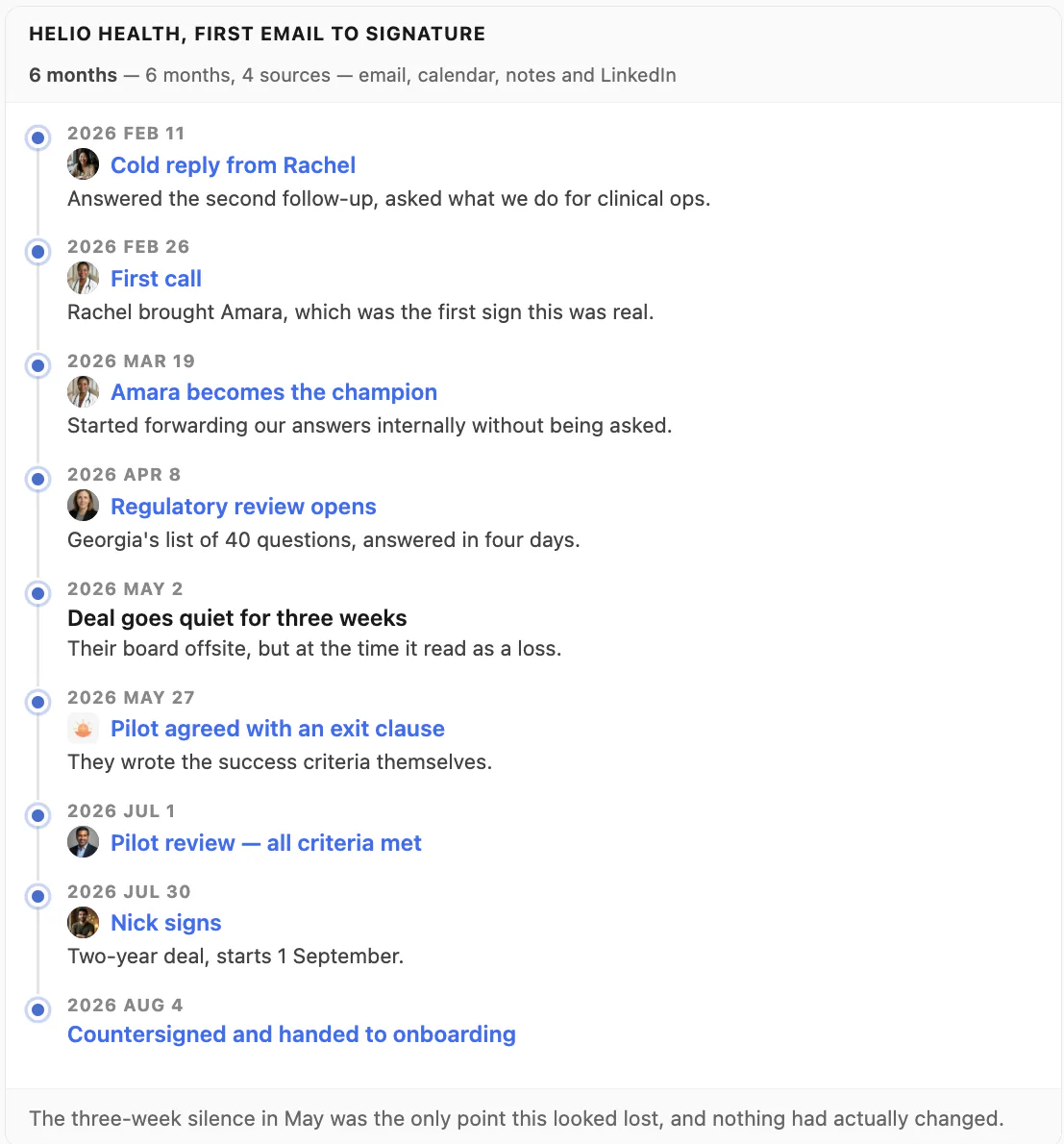
Six months with one customer, in order. This is what a real question on the next call is made of.
You grade your own self-promotion on how it feels to say it. They grade it on how it feels to hear it. Four studies on the gap, and on what works instead.
Six months with one customer, in order. This is what a real question on the next call is made of.
Ask an AI about this
These open a chat with the question already typed, pointed at this page. It asks for a balanced answer, including where Kola is the wrong choice.


Because the speaker and the listener are not feeling the same thing. You expect the listener to be pleased for you, and the listener is quietly counting how often you do this.
Irene Scopelliti, George Loewenstein and Joachim Vosgerau measured that gap in 2015, across three experiments. They had people describe their own successes, and had other people react to them.
Self-promoters overestimated how proud and how happy their listeners would feel. They also underestimated how annoyed those listeners would be.
The explanation the authors give is simple. People project their own feeling onto the person in front of them. Saying it feels good, so they assume it sounds good.
That is why the mistake repeats. Nothing in the moment tells you it landed badly, so the same move gets made again.
No. It is rated worse than a plain boast, and worse than a plain complaint. It is also the more common of the two ways to do it.
Ovul Sezer, Francesca Gino and Michael Norton ran nine studies on this in 2018, including a week-long diary study and a field experiment. They call it humblebragging: a boast wrapped in a complaint, or in false modesty.
In a nationally representative sample of 646 people in the United States, 70.1 per cent could recall one. Of those, 58.9 per cent were the complaint kind rather than the modesty kind.
In the diary study, 113 people reported what they heard each day for a week. On an average day 45.09 per cent had heard at least one, from 30.9 per cent on a Friday to 60.2 per cent on a Monday.
Rated better
I am really qualified for the job market.
Rated worse
Being too qualified on the job market sucks.
Those two sentences are from the study itself. Both forms of humblebrag reduced liking, perceived competence, compliance with requests and financial generosity, compared with straightforward bragging.
The reason the researchers found is sincerity. Braggers and complainers are not well liked either, but they are at least read as sincere. The combination is read as a tactic.
Asking. Across three studies of live conversations, people who asked more questions were better liked by the person they were talking to.
Karen Huang, Michael Yeomans, Alison Wood Brooks, Julia Minson and Francesca Gino published this in 2017. In the first study, 430 people were put into 215 pairs and told to chat online. Some were told to ask many questions, some to ask few.
The high question-askers were liked more. What explained it was responsiveness: listening, understanding, validation and care, as rated by their partner.
The participants did not anticipate the effect. People do not expect questions to make them better liked, which is exactly why they fill the time with statements.
Follow-up questions. They are the ones you could not have prepared, because they only exist if you listened to the last answer.
The same team ran a third study on speed dating. One hundred and ten men and women took part across three sessions, and the researchers analysed 1,961 yes-or-no second date decisions.
They trained a program to spot follow-up questions in the transcripts. An 8 per cent difference in follow-up question rate went with roughly one extra second date across an evening of 20 dates.
That last study is a field study, not an experiment, and its authors say plainly that it cannot be read as cause and effect. The causal evidence is in the two lab studies before it.
A first question can be prepared in the car. A follow-up question depends on the answer before it, and that is what makes it read as attention.
The measured result runs the other way. People who asked for advice were rated as more competent than people who asked for nothing.
Alison Wood Brooks, Francesca Gino and Maurice Schweitzer published that in 2015. Their starting point was that many people avoid asking because they fear looking incompetent.
Three things made the effect stronger. The task being hard rather than easy. The advice being asked of that person rather than of someone else. And the person asked being an expert.
None of that says the other person enjoys being asked. What it says is that the fear which keeps people quiet points the wrong way.
This is also the answer to having nothing to offer yet. We set out what counts as something to give in how to network without feeling fake.
Because it rests on a detail you no longer hold. Inside a conversation, listening is enough. Months later, you need something that wrote it down.
Where a person works is easy to keep. What goes is the specific thing: the migration they were dreading, the hire they could not make, the review that was coming in April.
Those details are the raw material. Without them you fall back on how things are going, and that question shows you remember nothing in particular.
| What the question needs | In the conversation | Six months later |
|---|---|---|
| What they said last | You just heard it | Gone unless written down |
| What they were worried about | Still in the room | Gone first |
| What you promised to send | Fresh | Remembered by them, not you |
| The question you can ask | A real follow-up | How are things going? |
Kola keeps the detail, so your next question can be about them. It reads the accounts you already use and holds everything in one file on your Mac.
Every person has a page. Emails, meetings, messages, notes and recorded calls sit on it, next to their company, role, location and birthday.
The note is the part that matters here. What they are building, what went wrong last quarter, the thing they said they were looking for. That is what a follow-up question is made of, and it is the first thing memory drops.
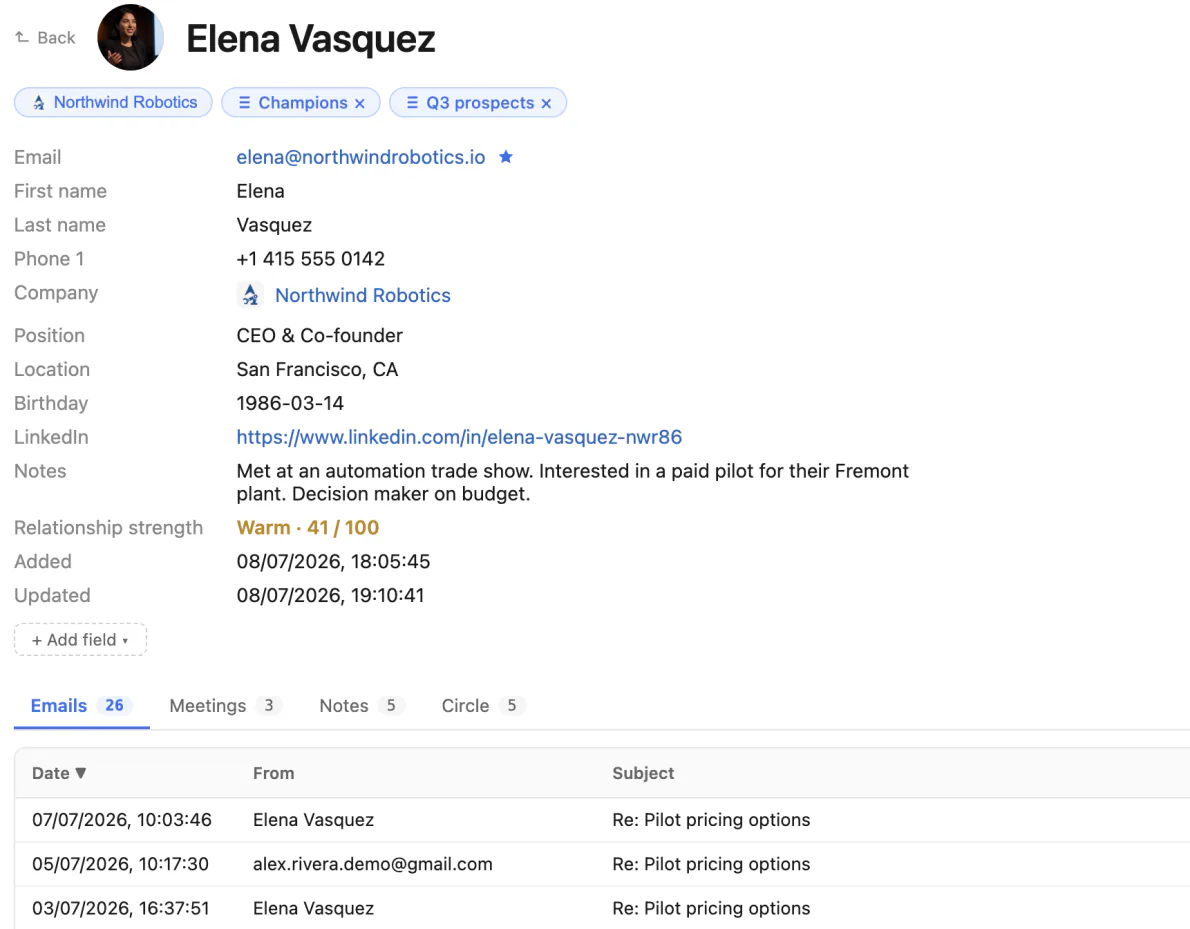
One person, and the two lines you would never have remembered. A year later, those lines are the question.
Search works by meaning rather than by keyword. Ask who was struggling to hire and you find the message that said "we have had the role open since March".
Kola can also read a person's recent public LinkedIn posts when you ask, and keeps nothing from them. That is how you react to this month's work instead of last year's job title.
Preparing before a call can also run on a schedule. A workflow in Kola is a name, an instruction in your own words, and a time. Kola runs it and writes what it found on a run page.
The before-the-call workflow
Every weekday at 07:30, look at today's meetings. For each person I am meeting, list what they told me last time we spoke, anything they said they were worried about, and anything I said I would send them. Give me one open question I could ask each of them. Do not send anything.
Nothing on that list is a script. It is the last answer, put back in front of you, so the next question can be a follow-up rather than an opener.
Writing to someone after years of silence is a different problem, with its own evidence. That one is in how to reconnect with someone professionally.
Kola brings the detail back. The question is still yours to ask.
Four published studies, all linked below. Nothing on this page was measured by us.
Why does self-promotion backfire?
Because the speaker and the listener are not feeling the same thing. Self-promoters overestimate how proud and happy their listeners will be, and underestimate how annoyed.
Is a humblebrag better than a plain brag?
No. Across nine studies, both kinds of humblebrag were rated worse than straightforward bragging, and a boast wrapped in a complaint was rated worse than just complaining.
Does asking questions make people like you?
In three studies of live conversations, yes, and follow-up questions carried most of it. The same studies found people do not expect this, which is why they keep talking about themselves instead.
Does asking for advice make you look incompetent?
The measured result runs the other way. People rated advice seekers as more competent than people who asked nothing, most of all on hard tasks and when the question went to an expert.
Where does Kola keep my contacts?
In one file on your Mac, under Application Support. Three features you switch on yourself do send data out, and the Security page names each one.
Install Kola and connect an account. Kola builds your contacts from there.