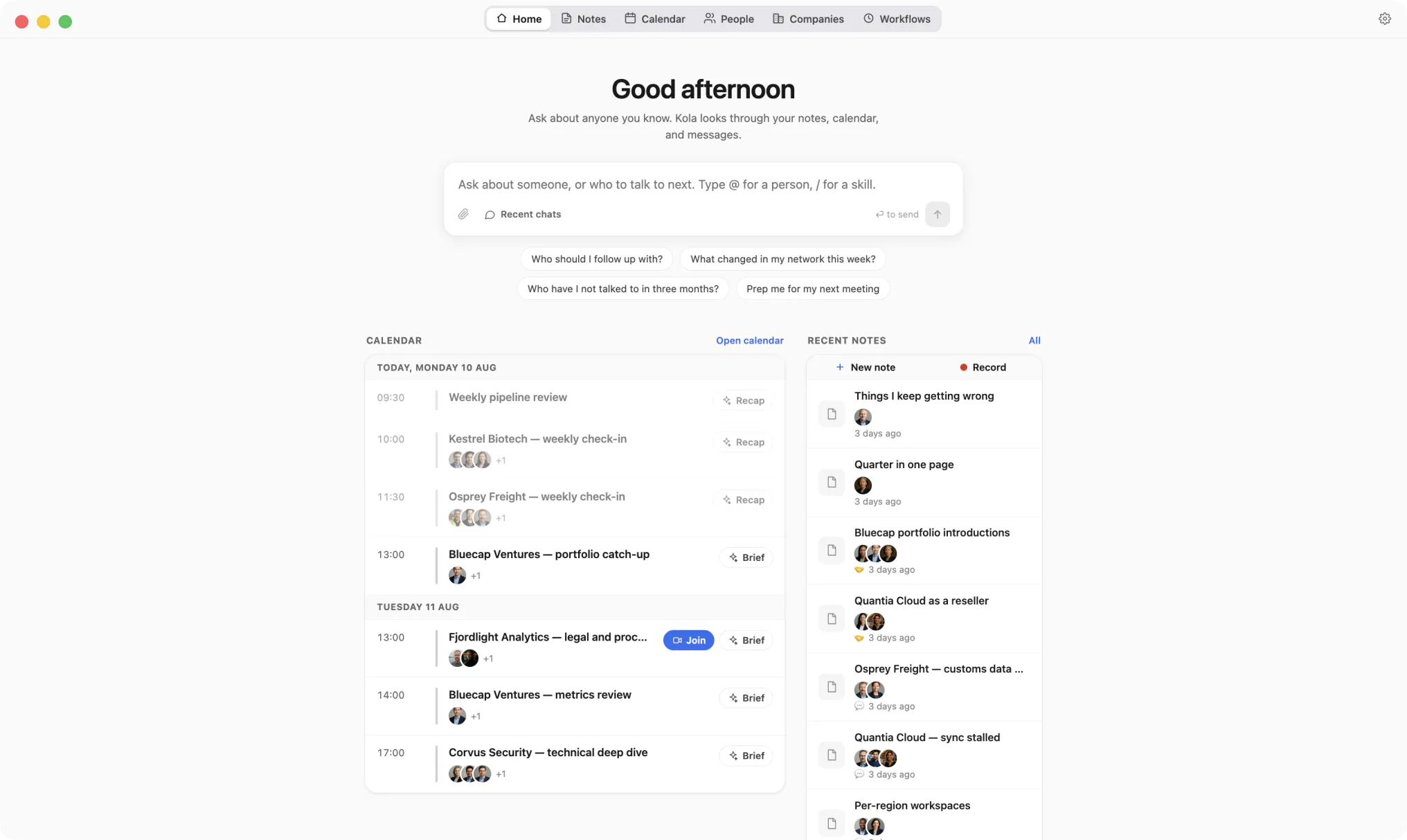
One place to ask, instead of four places to look. That is what the last step is for.
Six steps to a store you can trust. The hard part is capture, not how the folders are arranged.
One place to ask, instead of four places to look. That is what the last step is for.
Ask an AI how to build one
These open a chat with the question already typed, pointed at this page. It asks for a balanced answer, including where Kola is the wrong choice.


In six steps. Pick one place, decide what goes in, attach every capture to a person or a project, collect the half that arrives on its own, fix a time to review, and make sure you can search it with a sentence.
Four of the six are about what gets in. A store with holes in it stops being trusted, and then you go back to holding things in your head.
| The six steps | What you do |
|---|---|
| 1. Pick one place | One place, not four. A note in a fourth app is a note you will not find. |
| 2. Decide what goes in | Keep what you would be annoyed to lose and could not look up again. |
| 3. Attach every capture to a person | A person or a project. That is what brings it back later. |
| 4. Collect what arrives on its own | Mail, calendar, messages and calls need software, not a habit. |
| 5. Fix a time to review | Write it as "on Monday after coffee", never as "weekly". |
| 6. Search it with a sentence | You will remember what happened, not the keyword you typed. |
Steps one to three are decisions you make once, in an afternoon. Steps four to six decide whether the store is still in use next year.
Capture anything you would be annoyed to lose and could not look up again. Skip the rest, which is most of what people file.
An article can be found again. A public fact can be found again. What somebody told you in a room has no other copy, so it is the clearest case there is.
| Worth capturing | Skip it |
|---|---|
| What somebody told you on a call | An article you might read one day |
| What somebody said they were looking for | A public fact you can search for |
| A decision, and why you made it | A document already in the shared drive |
| A promise you made or were given | A screenshot of a web page |
| How you met someone, and who introduced you | Your own inbox, copied out by hand |
The reason to be strict is not tidiness. A store you trust frees you to learn the next thing, and that has been measured directly, which is the subject of what is a second brain, and does it work.
A narrow rule has one risk. Judge every item as it arrives and you will misjudge some of them. Step four is the answer to that, because what arrives on its own is kept whether you judged it worth keeping or not.
In one store, filed under the person or the project it belongs to. Not under the app it arrived in, which is the one thing you will not remember later.
Think about how you actually search. You start from a person and roughly when. You do not start from a folder name you chose eight months ago.
| What you remember later | What you do not |
|---|---|
| Who said it | Which app it was in |
| Roughly when | The words they used |
| What it was about | The file name you gave it |
| Who else was in the room | The folder you filed it under |
So file it under the person, and make the search work on meaning rather than on the exact words. Folders are still worth having. They are just not what brings a note back three months later.
Attach the review to something you already do, and write it as a specific time and place. That form has been through 94 independent tests, and on average it made people more likely to reach the goal they set.
Peter Gollwitzer and Paschal Sheeran gathered those studies in 2006, covering more than 8,000 people. The average effect on reaching a goal was 0.65 standard deviations.
"Review weekly" is a goal. "On Monday, after my first coffee, I will open the store and read last week" is a plan, and the plan is the form that was tested.
Expect it to take two months rather than three weeks. Phillippa Lally and colleagues followed 96 people carrying out one daily behaviour in a fixed context for 12 weeks.
The median time to reach near-automatic was 66 days, and the range ran from 18 to 254 days. The popular 21-day figure has no support in that data.
The habit only has to cover the half you write down. The half that arrives on its own should never depend on a habit at all.
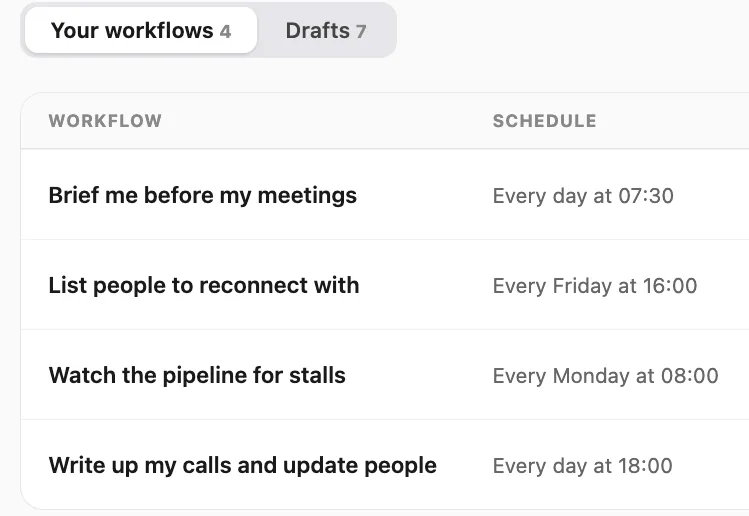
A review written as an instruction and a time. This is step five handed to software.
No. They are conventions for arranging notes, and the research on offloading measures something else: whether you trust the store to be there later.
Evan Risko and Sam Gilbert reviewed that whole area in 2016. People hand more over to a store when they expect it to be available and reliable when they come back.
Availability and reliability are properties of the store. They are not properties of a naming convention.
Both methods are worth reading and some people work well inside them. Neither is the thing that decides whether your store survives the year.
So pick the simplest structure you will still use in six months, and put the effort you saved into steps four and six.
Type, if you want to find it later. The famous result favouring handwriting did not hold up when it was run again.
Pam Mueller and Daniel Oppenheimer reported in 2014 that students who wrote notes by hand answered conceptual questions better than students who typed. It became one of the most quoted findings in the area.
Kayla Morehead, John Dunlosky and Katherine Rawson ran it again in 2019 with more groups. Performance did not consistently differ between any of them, including, in their second experiment, a group that took no notes at all.
Their combined analysis of the direct replications found a small effect favouring longhand that was not statistically significant. So the question is open, not settled the way it is usually quoted.
None of that makes handwriting useless. It does mean it is not a reason to keep your second brain on paper, and paper gets hard to search once there is a lot of it.
Kola collects it for you. You connect an account once, and what arrives is attached to the people it involves without being filed by hand.
It reads Gmail, Outlook and Apple Mail, Google and Outlook calendars, Google and Apple Contacts, Telegram, WhatsApp, Slack, LinkedIn, Instagram and Facebook. Each one is connected on its own, and can be disconnected on its own.
It also works out that one person is one person, even when they reach you from a work address, a personal address, Telegram and WhatsApp under four spellings of their name. That is step three, done for you.
Calls are the part with no other copy. Kola records and transcribes them on your Mac with Whisper running locally, then writes a summary of the decisions and what people promised to do.
You still write the other half. Mention a person in a note and the note attaches to their page, so it comes back when you ask about them rather than sitting in a folder.
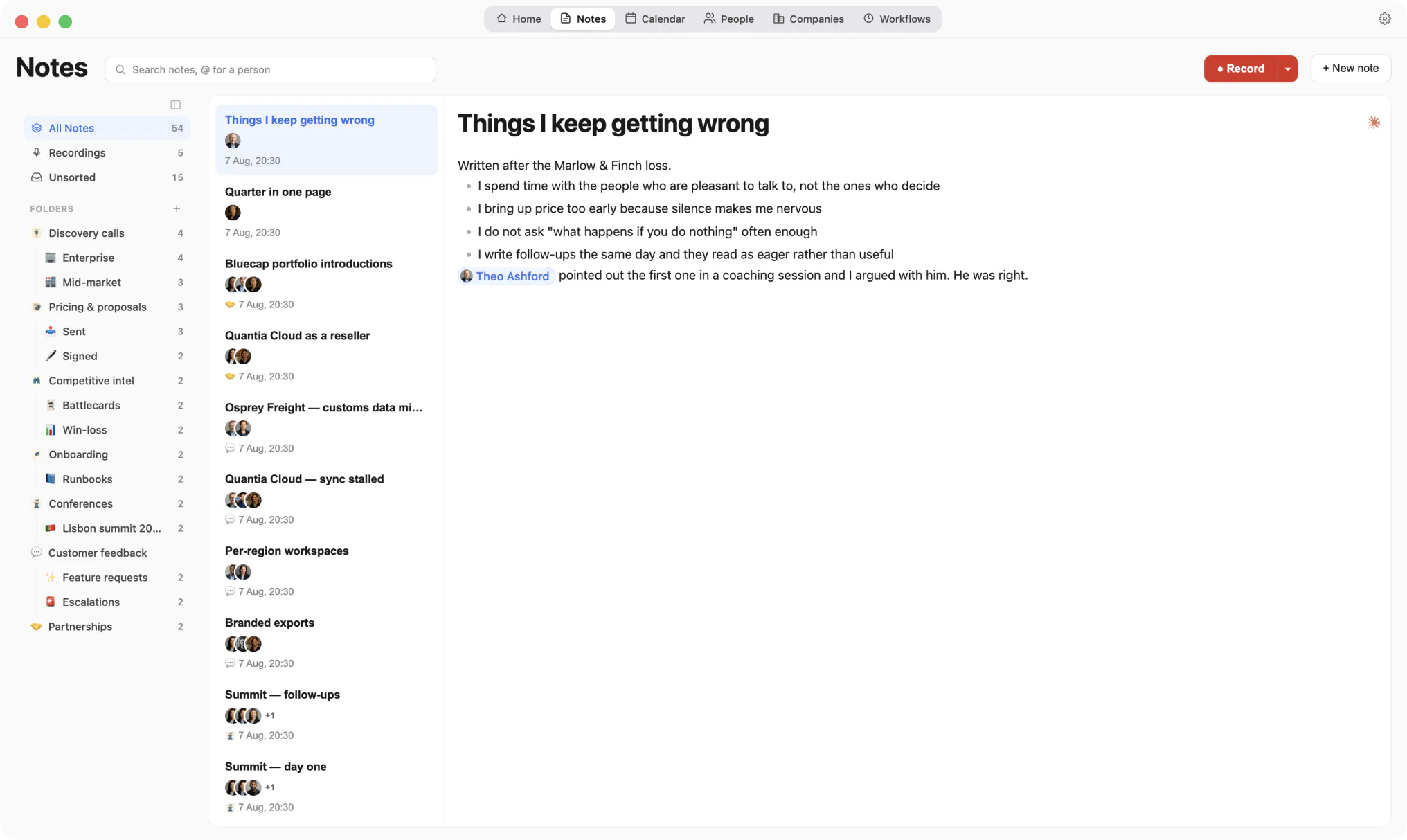
The people on a note are chips, not text. That is what attaches the note to a person.
Then you ask in a sentence, which is step six. Search works on meaning, so "who complained about onboarding" finds the message that said "the setup took us three weeks".
Every answer names where it came from. You can open the email or the note behind it and read the rest, which is what makes an answer checkable rather than plausible.
Step five can be handed over too. Write an instruction and give it a time, and Kola runs it on its own: "Every Monday at 07:30, tell me who I have not spoken to in three months."
All of it sits in one file on your Mac. Three features you switch on yourself do send data out, and the Security page names each one.
The honest limit is what Kola is built around. It is organised around people, so if your second brain is mostly ideas and documents with nobody in them, a notes app is the better fit.
Five published sources, all linked below. Nothing on this page was measured by us.
How do you build a second brain?
In six steps. Pick one place, decide what goes in, attach every capture to a person or a project, collect the half that arrives on its own, fix a time to review, and make sure you can search it with a sentence.
How long does it take to build the habit?
Longer than three weeks. In a study of 96 people, a daily behaviour took a median of 66 days to become near-automatic, and the range ran from 18 to 254 days.
What should you not put in a second brain?
Anything you could look up again. A saved article, a public fact and a document already in the shared drive all have another copy somewhere.
Do you need PARA or Zettelkasten?
No. They are conventions for arranging notes, and the research measures something else: whether you trust the store to be there later. Pick the simplest structure you will still use.
Is it better to take notes by hand or type them?
Type, if you want to find them later. The well-known result favouring handwriting did not hold when it was run again with more groups.
Install Kola and connect an account. Kola builds your contacts from there.