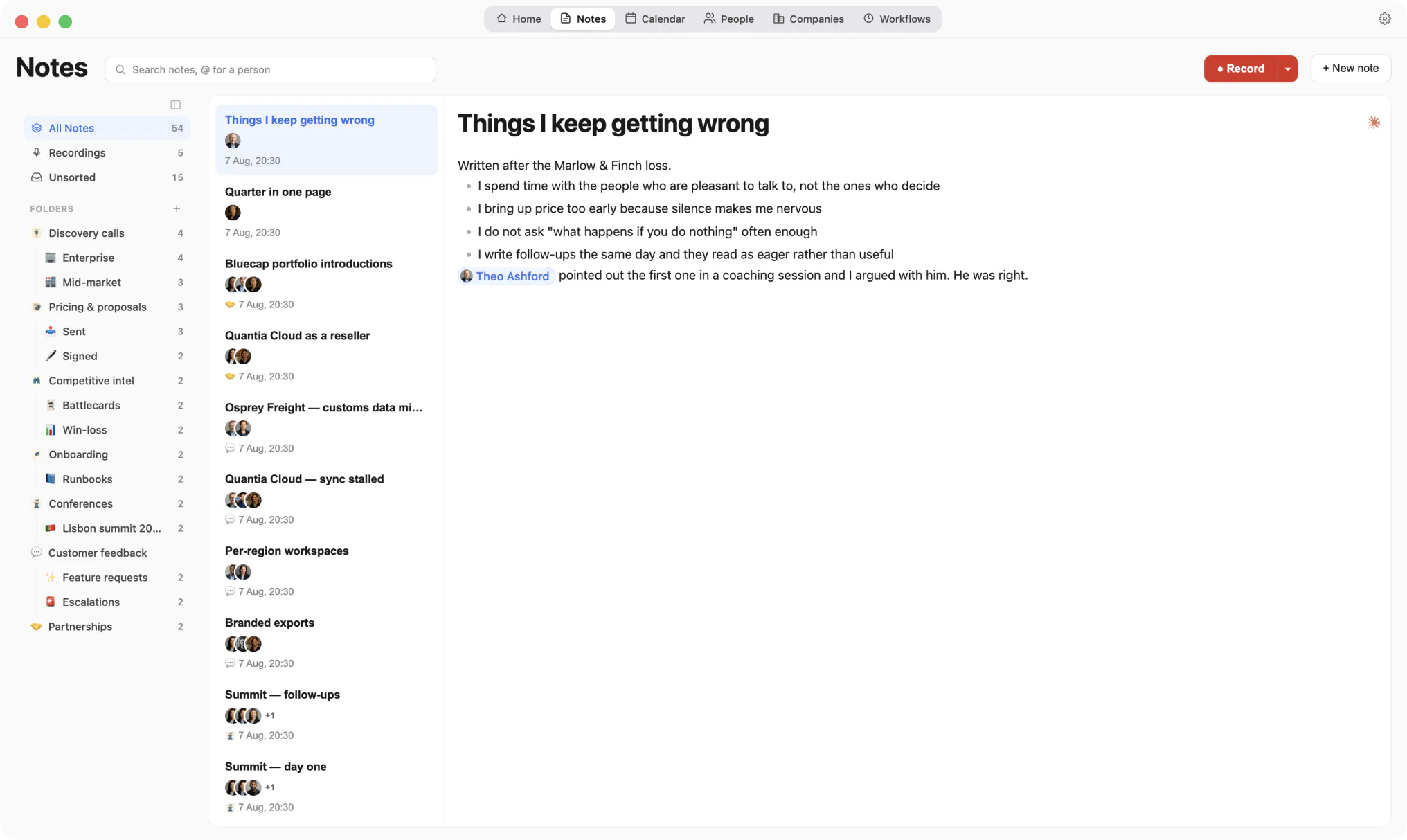
A note remembers who it is about. That is what brings it back months later, when you have forgotten you wrote it.
It is a store outside your head that you trust enough to stop holding things in it. The trust is the hard part, not the store.
A note remembers who it is about. That is what brings it back months later, when you have forgotten you wrote it.
Ask an AI about second brains
These open a chat with the question already typed, pointed at this page. It asks for a balanced answer, including where Kola is the wrong choice.


A second brain is a store outside your head for things you would otherwise try to remember. Notes, decisions, what people told you, what you promised.
The name was made popular by Tiago Forte in 2022. The idea is much older. Vannevar Bush described a machine for it in 1945 and called it the memex.
What makes it a second brain rather than a folder is that you stop keeping a copy in your head. That only happens once you believe the store will have the answer.
Storing something safely can help you learn the next thing. That is the clearest result in this area, and it was measured directly.
Benjamin Storm and Sean Stone ran it in 2015. People studied a list of words, then either saved the file or closed it without saving. Then they studied a second list.
The people who saved the first list remembered the second one better. Nothing about the second list changed. Only whether the first one was safely stored.
There is a related finding about unfinished tasks. An unmet goal keeps interrupting your thinking. E. J. Masicampo and Roy Baumeister showed that writing a specific plan stops those interruptions.
Both point the same way. A record you trust does something that a record you do not trust does not do. Neither study shows that writing alone is enough.
Evan Risko and Sam Gilbert reviewed this whole area in 2016 under the name cognitive offloading. Their review names the condition in the next section.
Probably not. This is the most quoted claim about second brains, and the study behind it has failed to replicate twice.
The original is Betsy Sparrow, Jenny Liu and Daniel Wegner in 2011. They reported that people who expect to be able to look something up remember where it is stored rather than what it said.
In 2018 the Social Sciences Replication Project retested 21 experiments from Science and Nature. Thirteen replicated. This one did not, in a test large enough to find an effect of the expected size.
Guido Hesselmann ran it again in 2020, using a design built to answer the original authors' objections. With data from 89 people, the results were five times more likely under no effect than under the original one.
A failed replication is not proof that nothing is there. It does mean the claim is too thin to build on. The offloading work above is a body of research rather than one result, so build on that instead.
Because capture is a job, and the job gets skipped. A store with holes in it is not trusted, and an untrusted store gets copied back into your head.
This is the condition Risko and Gilbert's review names. People offload more when they expect the store to be available and reliable later.
So the failure is not laziness. Filing is work, and in a busy week it is the work that gets dropped.
| What happened this week | Where it already exists |
|---|---|
| An idea you had | Only in your head |
| A decision you made | Only in your head |
| What was said on a call | Your calendar, and the recording |
| Who introduced you to whom | Your mail |
| What somebody asked you for | Your mail and your messages |
| When you last spoke to them | Every account you use |
The first two are yours to write, and nothing else holds them. The other four already exist in your mail, your calendar and your messages. Nobody should be retyping those.
Anything you would be annoyed to lose and cannot look up again. That test removes most of what people file, and keeps the part that matters.
An article can be found again. A public fact can be found again. What somebody told you in a room has no other copy, so it is the clearest case of all.
The most useful of those is what somebody said they were looking for. Months later it is the thing you can help with, which is the subject of how do you network without feeling fake.
It helps to split the store in two. Things you write down, and things that happen to you. They fail for different reasons and they need different handling.
| Two halves of a second brain | Things you write | Things that happen to you |
|---|---|---|
| Examples | Ideas, decisions, drafts | Emails, meetings, messages |
| How it arrives | You type it | It arrives whether you act or not |
| Why it goes missing | You were busy | It was never collected in one place |
| What fixes it | A habit | Software that collects it for you |
Most second brain advice is about the left column. The right column needs collecting, not a better habit.
Kola holds both columns in one file on your Mac. You write the left one. Kola collects the right one from the accounts you connect.
The notes are a full note system. Nested folders, pasted screenshots and dragged files, and search across every word you have written.
A note can also name a person. From then on it comes back whenever you ask about them, without being filed anywhere special.
Calls are the third piece. Kola records a meeting, writes the transcript and the summary, and keeps both next to the people who were in the room.
Emails, meetings and messages are attached to the people they involve. Nothing has to be filed under a person by hand.
Then you ask in a sentence rather than guessing a keyword. Search works by meaning, so "who complained about onboarding" finds the message that said "the setup took us three weeks".
Every answer names where it came from. You can open the email or the note behind it and read the rest, which is what makes the answer checkable.
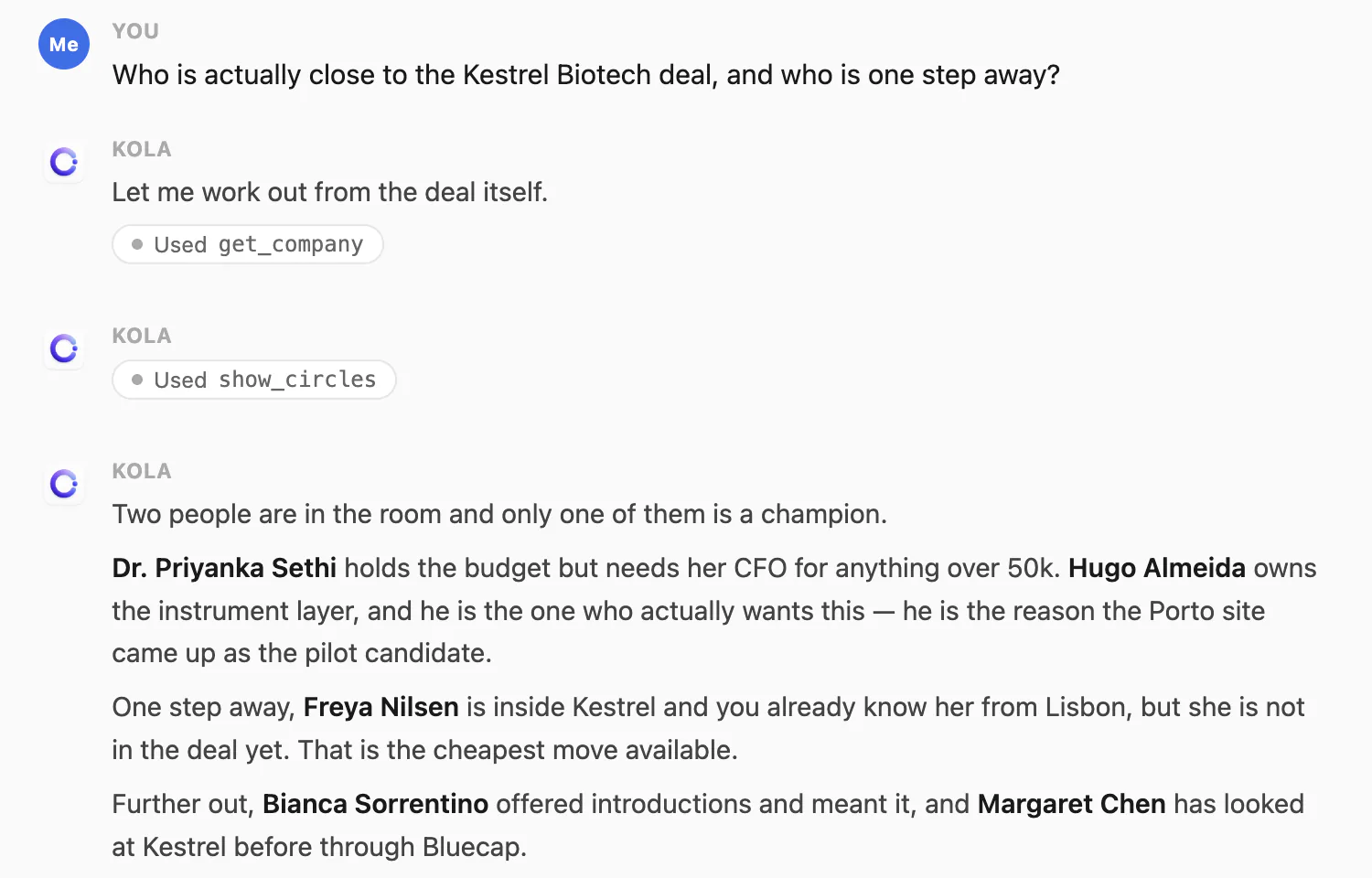
The answer names people and says what each one holds. The chips show which records it read to get there.
There is also a page about you. At night Kola reads what you wrote that week. It keeps a short summary of what you are working on and how you like things done.
That pass uses only your own writing. Pasted emails and what other people said in meetings are filtered out of the input before it runs.
Every revision is kept, so a night that got you wrong can be rolled back. You can read the page and edit it yourself.
Notes, calls and people sit in the same file, so one question can draw on all three. A note you wrote, a line somebody said on a call, and the thread it came from are one search apart.
The honest limit is the machine. Kola runs on a Mac, and what it keeps lives in one file there.
Five published sources, all linked below. Nothing on this page was measured by us.
What is a second brain in simple terms?
A store outside your head that holds what you would otherwise try to remember. It works when you trust it enough to stop holding the same thing twice.
Does keeping a second brain make your memory worse?
The evidence points the other way. In one experiment, saving a first list of words improved how well people learned the second list.
Why do most second brains stop working?
Because filing is a job, and the job gets skipped in a busy week. Once the store has holes in it, you go back to holding things in your head.
What should you put in a second brain?
Anything you would be annoyed to lose and cannot look up again. What people told you is the clearest case, because there is no other copy.
Where does Kola keep my notes?
In one file on your Mac, under Application Support. Three features you switch on yourself do send data out, and the Security page names each one.
Install Kola and connect an account. Kola builds your contacts from there.